
About IMR Powder
Century-Old Improved Military Rifle Smokeless Propellants
IMR Powder: History & Engineering
Created by DuPont in 1914 as Improved Military Rifle tubular smokeless powder and acquired by Hodgdon in 2003, home to IMR 4227, 4064, 4895, and 4350.
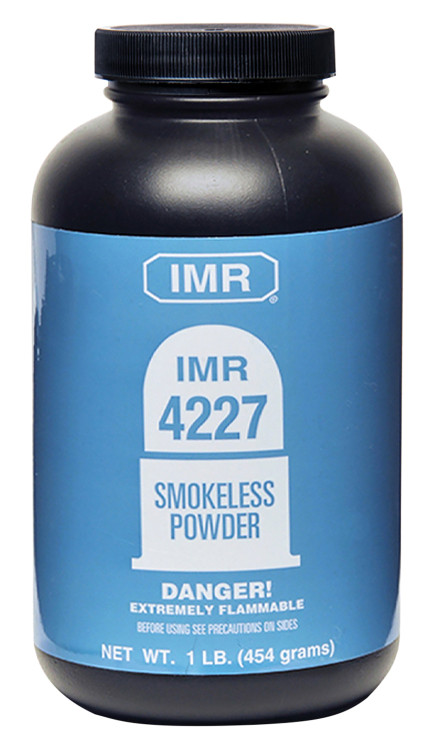
Standing for Improved Military Rifle, IMR Powder represents more than a century of American ballistic chemistry. Developed by E.I. du Pont de Nemours and Company beginning around 1914 - miniaturizing John Bernadou's 1897 single-base nitrocellulose artillery propellant into progressive-burning tubular grains for military rifles - IMR powered U.S. service ammunition through both World Wars before transforming civilian handloading in the 1930s with iconic numbers like IMR 3031, IMR 4064, IMR 4350, and IMR 4227. Acquired by Shawnee, Kansas-based Hodgdon Powder Company in 2003, the IMR marque continues to anchor American handloading benches with legendary extruded propellants including IMR 4227.
Origins: DuPont, World War I & The Iconic 4000-Series
At the dawn of the twentieth century, early smokeless rifle powders suffered from fierce flame temperatures that rapidly eroded steel barrels and erratic pressure spikes across seasonal temperatures. Drawing on naval officer John Bernadou's single-base nitrocellulose patents, DuPont chemists refined a coated, perforated tubular extruded grain treated with dinitrotoluene (DNT) deterrents and conductive graphite. Designated Improved Military Rifle (IMR) beginning in 1914, the new propellant burned cleanly, cooled throat temperatures, and delivered unmatched velocity uniformity in .30-06 Springfield military service cartridges during World War I.
During the Great Depression in the 1930s, DuPont unveiled a modernized civilian canister lineup - introducing IMR 3031 (1934), IMR 4064 (1935), IMR 4227, and IMR 4350 (1940) - whose four-digit designations remain etched in the memory of virtually every American reloader. After decades under DuPont and later IMR Powder Company corporate successors, Shawnee, Kansas-based Hodgdon Powder Company acquired the IMR brand in 2003, safeguarding its classic formulas while adding modern Enduron copper-fouling-eraser and temperature-insensitive blends.
Tubular Extrusion Chemistry & IMR 4227 Versatility
IMR's trademark engineering strength is precise extruded-grain geometry. By controlling the exact length, diameter, perforation size, and deterrent coating of every nitrocellulose cylinder, IMR tailors progressive burn curves across the entire spectrum from fast magnum handguns to slow overbore rifle magnums. That fine-tuned burn control shows clearly in IMR 4227 Smokeless Powder (stocked at Global Ordnance in 1 lb canisters, SKU 942271), the fastest-burning member of the historic IMR 4000-series rifle-and-magnum-pistol family.
Prized by generations of revolver hunters, silhouette competitors, and small-case rifle reloaders, IMR 4227 occupies a coveted burn-rate sweet spot ideal for heavy-bullet magnum handgun cartridges including .357 Magnum, .41 Magnum, .44 Magnum, .454 Casull, and .500 S&W Magnum, while also shining in classic small-capacity centerfire rifles such as .22 Hornet, .218 Bee, .221 Remington Fireball, .30 Carbine, and .300 Blackout. Its dense, short-cut extruded grains deliver high load density inside straight-walled magnum cases, promoting uniform ignition and low velocity spreads with standard or magnum primers per published load recipes.
Market Position, Key Peers & Reloading Ecosystem at Global Ordnance
On the reloading bench stocked at Global Ordnance, IMR Powder stands alongside parent brand Hodgdon and historic American rival Alliant Powder, working reliably with presses, scales, dies, and components from RCBS, Hornady, Lyman, and Starline Brass. While Alliant dominates classic double-base flake handgun powders and Hodgdon's Extreme line leads modern temperature-insensitive rifle propellants, IMR retains unmatched century-old load-manual depth - virtually every reloading book printed since 1935 lists proven accuracy loads built around IMR propellants.
Global Ordnance stocks factory-sealed IMR 4227 Smokeless Powder (1 lb canister) ready to power your next batch of magnum revolver hunting loads, .300 Blackout carbines, or classic .22 Hornet varmint cartridges.