
Buffalo Bore
-
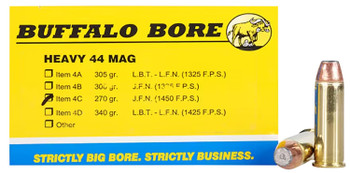
Buffalo Bore Heavy .44 Remington Magnum Ammunition 270 gr Semi-Jacketed Flat Point - 4C20
Buffalo Bore
$51.47What matters most in a .44 Magnum load is the balance of weight and velocity. This Buffalo Bore lot pushes a 270 grain semi-jacketed flat-point bullet to roughly 1,450 fps, giving you a hard-hitting...$51.47 -
Buffalo Bore Heavy .444 Marlin 300 gr Semi-Jacketed Flat Point - 9B20
Buffalo Bore
$67.82If you’re hunting big game with a .444 Marlin, you need a bullet that can punch through tough hide and bone without over-penetrating. This Buffalo Bore load pairs a 300-grain semi-jacketed flat-point...$67.82 -
Buffalo Bore Heavy 480 Ruger 370 gr Lead Flat Nose - 13B20
Buffalo Bore
$69.94If you need a .480 Ruger load that punches through big game without the wall-oping recoil of the full-power offerings, this 370 gr lead flat-nose round hits the sweet spot. The heavy bullet drives at...$69.94 -
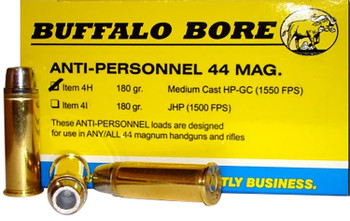
Buffalo Bore Anti-Personnel .44 Remington Magnum 180 gr MCHP Handgun Ammo - 4H20
Buffalo Bore
$43.76A .44 Remington Magnum load aimed at defensive shooters, this ammo pairs a 180-grain medium-cast hollow-point with flash-suppressed powder. The light-for-caliber bullet keeps recoil manageable while...$43.76 -
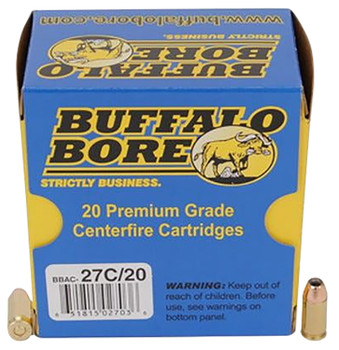
Buffalo Bore Personal Defense Strictly Business .380 ACP +P 90gr JHP - 27C20
Buffalo Bore
$28.27A .380 ACP +P load needs a bullet that expands without over-penetrating. Buffalo Bore’s 90-grain jacketed hollow-point does exactly that, delivering consistent expansion for reliable stopping power...$28.27 -

Buffalo Bore Heavy .44 S&W Special 200 gr Barnes TAC-XP Lead-Free - 14D20
Buffalo Bore
$55.06The 200-grain Barnes TAC-XP bullet is a copper-based, lead-free design that expands reliably while delivering deep penetration-perfect for defensive or hunting scenarios where a non-lead projectile...$55.06
Brand Archive · Est. 1997
Buffalo Bore Ammunition: History & Engineering
Founded in 1997 by lifelong hunter and handloader Tim Sundles in Salmon, Idaho, Buffalo Bore Ammunition fills a technical void left by mainstream ammunition factories that load traditional cartridges well below their SAAMI pressure ceilings. Drawing on decades of field handloading experience across Idaho and Oregon, Sundles established the first commercial factory production for heavy custom wheelgun cartridges such as the .475 Linebaugh and .500 Linebaugh. Today, Buffalo Bore produces high-velocity, flash-suppressed defensive loads and hard-cast Outdoorsman cartridges trusted by wilderness guides, hunters, and defensive shooters who carry revolvers and semi-automatics in dangerous-game country.
Origins & Early Milestones
Tim Sundles learned to handload from his stepfather at age twelve while hunting in the rugged mountains of Idaho and Oregon. By the mid-1990s, Sundles recognized that major factories routinely underloaded classic hunting and defense rounds to accommodate century-old firearms, leaving substantial ballistic performance on the table in modern steel revolvers from Ruger and Smith & Wesson. Launching Buffalo Bore Ammunition in 1997 in Salmon, Idaho, he built a small-batch production line dedicated to real-world velocity measured in standard production guns rather than oversized lab test barrels.
Buffalo Bore earned immediate credibility among big-bore handgunners by becoming the first commercial manufacturer to produce factory ammunition for John Linebaugh's custom .475 Linebaugh and .500 Linebaugh cartridges. Throughout the early 2000s, the company expanded aggressively into +P defensive handgun loads, low-flash tactical offerings, and high-pressure lever-action rifle cartridges like .45-70 Government and .30-30 Winchester, establishing a fiercely loyal following among Alaskan guides, ranchers, and backcountry outfitters.
Landmark Platforms
Rather than chasing proprietary bullet jackets, Buffalo Bore engineers complete ballistic systems around proven specialty projectiles, custom-blended flash-suppressed propellants, and strict pressure calibration. Its Outdoorsman series pairs heavy, flat-nosed hard-cast lead bullets (often treated with gas checks or heavy-duty wax lubes) with full-power charges to achieve deep, straight-line penetration through heavy bone and dense muscle. This approach transformed everyday service calibers like 9mm Luger, .45 ACP, and 10mm Auto into legitimate woods-defense alternatives alongside traditional .357 Magnum and .44 Magnum revolvers.
For personal protection and hunting, Buffalo Bore integrates bonded hollow points, Barnes Bullets solid-copper monometal projectiles, and heavy-for-caliber jacketed bullets from makers like Hornady and Sierra Bullets. Their Standard Pressure and +P Short Barrel defensive lines utilize low-flash powders specifically tuned to burn efficiently in snub-nose .38 Special revolvers and compact semi-automatics, minimizing blinding muzzle signature in low-light encounters while delivering reliable terminal expansion.
Market Position & Key Peers
In the specialty ammunition segment, Buffalo Bore competes directly with Montana neighbor HSM Ammunition in the bear-defense hard-cast category, while offering higher-velocity, niche alternatives to high-volume loads from Federal Ammunition, Speer, and Hornady. Where mainstream factories prioritize mass-market compatibility across every vintage firearm ever built, Buffalo Bore publishes explicit firearm compatibility guidance so shooters running strong modern actions from Ruger, Glock, Springfield Armory, and Henry Repeating Arms can access maximum safe ballistic output.
At Global Ordnance, shoppers can source Buffalo Bore's core Outdoorsman hard-cast lines, Anti-Personnel defensive +P cartridges, and Heavy Magnum rifle and revolver loads across calibers ranging from .380 ACP and 9mm Luger to .44 Magnum, .45 Colt, .454 Casull, and .45-70 Government. Every box reflects small-batch Idaho assembly and chronograph-verified real-gun velocity data.