
About Christensen Arms
Aerospace Carbon-Fiber Rifle Pioneers
Christensen Arms: History & Engineering
Founded by aerospace engineer Roland Christensen in Utah in 1995, Christensen Arms pioneered carbon-fiber-wrapped rifle barrels for ultralight Ridgeline, Evoke, and MPR precision platforms.
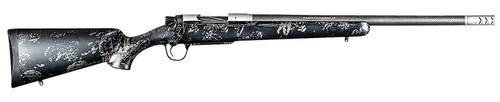
Christensen Arms was founded in 1995 in Fayette, Utah, by aerospace mechanical engineer Roland Christensen, who spent his early career designing advanced carbon-fiber composite structures for aircraft and prosthetic applications. Applying aerospace filament-winding and tensioning science to rifled stainless-steel cores, Christensen created the firearms industry's first commercially viable carbon-fiber-wrapped rifle barrel. Now headquartered in a vertically integrated manufacturing campus in Gunnison, Utah, Christensen Arms machines its own receivers, winds its own barrels, and hand-lays carbon-fiber stocks for the flagship Ridgeline, Modern Precision Rifle (MPR), Mesa, and Evoke bolt-action series as well as carbon-barreled AR rifles.
Origins & Early Milestones
When Roland Christensen began experimenting with carbon-composite barrel wrapping in his Utah garage in 1995, Western mountain hunters faced an unavoidable trade-off: thin sporter steel barrels saved weight on steep climbs but heated quickly and drifted off zero, whereas heavy match barrels held sub-MOA precision at exhausting weight penalties. Drawing on aerospace resin matrices and directional carbon layups, Christensen machined a button-rifled 416R stainless-steel core down to a precise profile and wound high-modulus carbon fiber over the exterior under controlled tension, creating a stiffer, lighter barrel that dissipated heat faster than comparable steel.
Early Christensen Arms custom rifles built on tuned Remington 700 actions quickly won over sheep, elk, and long-range mountain hunters across the Rocky Mountain West. As demand scaled, the company consolidated machining, barrel wrapping, composite stock molding, and final assembly under one roof in Gunnison, Utah. Over the 2010s, Christensen Arms transitioned from custom shop to full-scale production manufacturer, launching its own proprietary Remington 700-footprint stainless and titanium receivers alongside the sub-MOA Ridgeline hunting rifle and folding-chassis Modern Precision Rifle.
Landmark Platforms
Christensen Arms' Aerograde carbon-fiber barrel remains its defining technical pillar. Starting with a match-grade 416R stainless steel liner honed to tight internal tolerances, technicians wind multiple directional plies of aerospace carbon fiber and heat-conducting epoxy around the barrel before curing and precision-finishing the exterior. Because carbon fiber possesses a higher stiffness-to-weight ratio than steel, an Aerograde barrel achieves bull-barrel harmonic rigidity at the weight of a pencil-thin sporter while reducing mirage and thermal stringing across rapid shots.
That barrel architecture anchors a diverse modern lineup. The Ridgeline and Ridgeline FFT (Flash Forged Technology) pair Aerograde carbon barrels with hand-laid carbon stocks and stainless or titanium actions, trimming backcountry rifle weights down to roughly 5.3 pounds in calibers from 6.5 Creedmoor and 6.5 PRC to 7mm PRC and .300 Win Mag. For tactical and precision shooters, the Modern Precision Rifle (MPR) places a carbon barrel inside a 7075 billet aluminum folding chassis weighing under 7.5 pounds, while the stainless-barreled Mesa and budget-friendly Evoke extend Christensen Arms' TriggerTech triggers and sub-MOA guarantees to value-conscious hunters.
Market Position & Key Peers
Christensen Arms helped define the modern ultralight Western mountain rifle category and remains one of its highest-volume innovators. In carbon-barreled hunting rifles, the Ridgeline FFT, Traverse, and FFT Titanium compete head-to-head with Fierce Firearms Carbon Rival and Rogue rifles, Bergara Premier Divide and Crest models, Weatherby Mark V Backcountry rifles, and Browning X-Bolt Pro Carbon builds. Because Christensen Arms standardizes on Remington 700-style scope base mounting, TriggerTech frictionless triggers, and radial or side-baffle stainless muzzle brakes, shooters can configure rifles cleanly with Warne or Talley mounts and Dead Air or SilencerCo hunting suppressors.
Beyond centerfire bolt guns, Christensen Arms also builds the Ranger 22 carbon-barreled rimfire trainer and CA-15 G2 / CA-10 carbon-wrapped modern sporting rifles in 5.56 NATO and .308 Winchester. Hunters and long-range shooters sourcing Christensen Arms platforms at Global Ordnance pair them with Hornady Precision Hunter, Nosler Trophy Grade, or Barnes Bullets VOR-TX ammunition for flat-shooting Western terminal performance.
Featured In-Stock Christensen Arms Products at Global Ordnance
Christensen Arms Ridgeline FFT Titanium 7mm PRC 3+1 22" Carbon-Fiber Stock - 8010632800$2,449.99 Christensen Arms Ridgeline FFT Titanium 6.5 PRC 20" Threaded Barrel - 801-06222-00$2,389.02
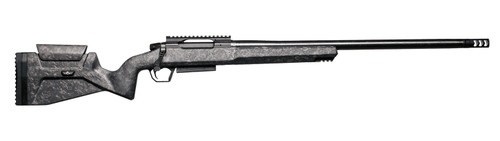 Christensen Arms Modern Carbon Rifle (MCR) .22 Creedmoor 20" Threaded Barrel - 801-14060-00$2,329.99
 Christensen Arms Modern Precision .338 Lapua Magnum 27" Threaded Barrel - 8010301201$2,222.34