
About Nosler
Oregon Hunting Ballistics Pioneer

Nosler: History & Engineering
Family-owned Bend, Oregon innovator behind the 1948 Partition dual-core bullet, Ballistic Tip, AccuBond bonded projectiles, custom brass, and the 28 Nosler cartridge family.
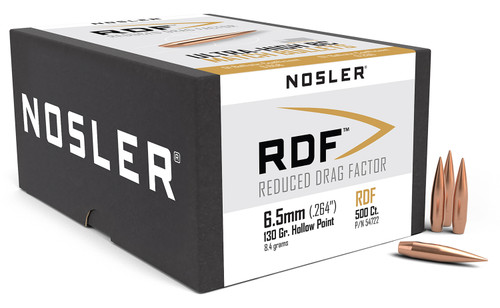
Born from a frustrating 1946 British Columbia moose hunt where standard cup-and-core rifle bullets failed to penetrate mud-caked hide and heavy shoulder bone, Nosler was founded in 1948 by John A. Nosler to engineer a stronger big-game projectile. Turning solid copper-alloy jackets on a screw machine in Ashland before relocating permanently to Bend, Oregon in 1958, John Nosler invented the dual-core Partition bullet and established an enduring standard for controlled terminal expansion. Still privately owned by the Nosler family, the company has expanded into Ballistic Tip, AccuBond, and Expansion Tip copper projectiles, match-grade reloading brass, Trophy Grade loaded ammunition, and proprietary flat-shooting cartridges led by the 28 Nosler.
Origins & Early Milestones
In the autumn of 1946, California trucking company owner and avid sportsman John A. Nosler stalked a massive bull moose across muddy British Columbia timber armed with a .300 H&H Magnum. Although his shots struck squarely in the vitals, contemporary thin-jacketed cup-and-core bullets shattered against mud and heavy muscle before reaching the heart, forcing multiple follow-up shots. Determined to solve the contradiction between rapid expansion and deep penetration, Nosler returned to Oregon and began machining heavy H-shaped copper-alloy jackets with an integral horizontal wall dividing two independent lead cores.
After proving his hand-turned dual-core bullets on a subsequent Canadian moose hunt, John established the Nosler Partition Bullet Company in 1948 in Ashland, Oregon. Early screw-machine production yielded slow batches prized by Alaska and Rocky Mountain guides, until Nosler partnered with impact-extrusion engineers to scale manufacturing without sacrificing concentricity. Moving the factory to Bend, Oregon in 1958 positioned Nosler for decades of multi-generational family growth under John's son Bob Nosler and grandson John R. Nosler, adding full ballistic test ranges, automated inspection lines, and the respected Nosler Reloading Guide first published in 1976.
Landmark Platforms
Nosler reshaped big-game terminal ballistics across four distinct projectile eras. The original 1948 Partition remains a benchmark because its unbonded front core mushrooms reliably at modest impact velocities while its solid copper center partition protects the rear lead core, guaranteeing 60 to 70 percent retained weight and deep straight-line penetration through heavy bone. In 1984, Nosler launched the Ballistic Tip, introducing caliber-color-coded polycarbonate noses seated inside tapered boat-tail jackets to streamline aerodynamics for whitetail, pronghorn, and varmint hunters firing .243 Winchester, .270 Winchester, and .308 Winchester rifles.
Recognizing the need for a high-ballistic-coefficient bullet tougher than standard Ballistic Tips, Nosler unveiled the bonded AccuBond in 2003, metallurgically welding a tapered copper jacket to a lead-alloy core to stop jacket-core separation at magnum impact speeds. Subsequent breakthroughs included the monolithic lead-free E-Tip (Expansion Tip), the sleek AccuBond Long Range designed to expand down to 1,300 fps, and a complete family of proprietary non-belted magnum cartridges built on shortened .404 Jeffery parent geometry: the 26 Nosler (2014), 28 Nosler (2015), 30 Nosler, 33 Nosler, and 27 Nosler.
Market Position & Key Peers
In the premium hunting projectile and factory ammunition sector, Nosler competes directly alongside Hornady, Barnes Bullets, Sierra Bullets, and Speer while simultaneously serving as an OEM bullet supplier for select Federal Ammunition and Winchester Ammunition premium hunting loads. By vertically integrating bullet forming, weight-sorted Nosler brass, Trophy Grade factory ammunition, and even precision hunting rifles, Nosler delivers cohesive ballistic systems tailored for western mountain hunters running Bergara, Christensen Arms, Fierce Firearms, Weatherby, and Browning rifles.
Global Ordnance stocks a strong inventory of Nosler component projectiles, prepped brass, and Trophy Grade, Ballistic Tip, and Whitetail Country factory ammunition. Reloaders equipping benches with RCBS, Lyman, or Area 419 tools can source Partition, AccuBond, Ballistic Tip, E-Tip, and Custom Competition HPBT bullets across popular rifle diameters. Factory ammunition buyers can stock proven hunting loads in 6.5 Creedmoor, .308 Winchester, .30-06 Springfield, 7mm Rem Mag, .300 Win Mag, and 28 Nosler ready for fall hunts.
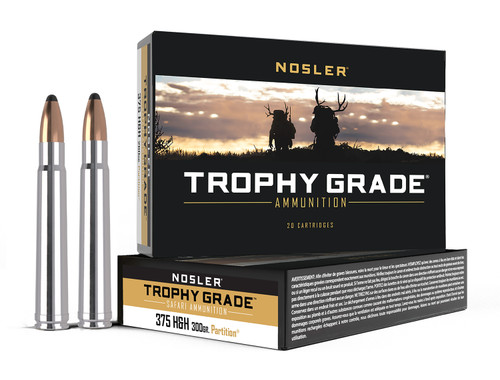 Nosler Safari .375 H&H Magnum 300 gr Partition - 40606
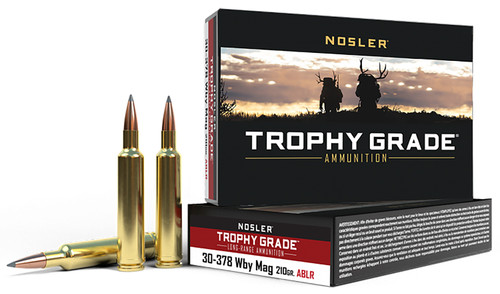 Nosler Trophy Grade Long-Range .30-378 Weatherby Magnum 210 gr AccuBond - 60133
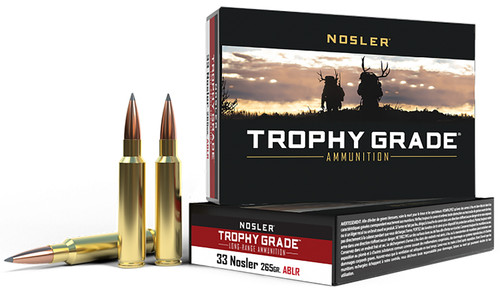 Nosler Trophy Grade Long Range 33 Nosler 265 gr AccuBond - 60099