
About Remington Ammunition
Big Green Ballistic Legacy
About Remington Ammunition: History, Engineering & Legacy
Lonoke, Arkansas cartridge manufacturer uniting 1867 UMC heritage with Core-Lokt controlled-expansion hunting bullets, Golden Saber duty loads, and STS competition shotshells.

Tracing its metallic cartridge lineage to the 1867 founding of the Union Metallic Cartridge Company in Bridgeport, Connecticut and its 1912 consolidation with Eliphalet Remington's historic firearms firm, Remington Ammunition represents over 150 years of American ballistic innovation. Known across hunting camps and clay ranges as Big Green, the company pioneered the Kleanbore non-corrosive primer in 1927, introduced the legendary Core-Lokt controlled-expansion hunting bullet in 1939, and established its sprawling 1,000-acre manufacturing complex in Lonoke, Arkansas in 1969. Revitalized under The Kinetic Group and CSG ownership, Remington Ammunition continues rolling out rifle, handgun, rimfire, and shotshell loads from its Arkansas heartland.
Origins, Founder & Early Milestones
While Eliphalet Remington forged his first flintlock barrel in Ilion, New York in 1816, Remington's dedicated ammunition division grew directly from the Union Metallic Cartridge Company (UMC), organized in Bridgeport, Connecticut in 1867 by Marcellus Hartley and partners to meet surging post-Civil War demand for self-contained brass cartridges. UMC quickly became America's largest metallic cartridge producer, introducing paper-hulled shotshells and centerfire rifle rounds for the expanding western frontier. Hartley's group purchased Remington in 1888 and formally merged the two operations in 1912 as Remington UMC, a headstamp still seen on value-priced range ammunition more than a century later.
During the interwar period, Remington chemists achieved a decisive breakthrough in 1927 with Kleanbore non-corrosive primers, replacing corrosive potassium chlorate compounds that had pitted rifle bores since the advent of percussion ignition. As mid-century civilian and sporting demand outgrew its crowded Connecticut facilities, Remington constructed a purpose-built manufacturing campus on over 1,000 acres in Lonoke, Arkansas, commencing full operations in 1969. Today, Lonoke's workforce runs integrated brass drawing, lead smelting, primer mixing, and automated high-speed loading lines under one million square feet of roof.
Landmark Platforms & Engineering Breakthroughs
Few projectiles in sporting history match the longevity of Remington's 1939 Core-Lokt bullet. Marketed as the deadliest mushroom in the woods, Core-Lokt was the original commercially mass-produced controlled-expansion hunting bullet, utilizing a thickened midsection jacket mechanically locked into its lead core to expand reliably to nearly twice its caliber while preserving mass for deep vital penetration. In 2021, Remington modernized the family with Core-Lokt Tipped, pairing the locked jacket foundation with a high-ballistic-coefficient green polymer tip tuned for extended-range shooting in 6.5 Creedmoor, .308 Winchester, and .30-06 Springfield.
Beyond deer woods, Remington standardized several of the world's most popular commercial cartridges, including .223 Remington, .22-250 Remington, 7mm-08 Remington, and 7mm Rem Mag. In defensive handgun ballistics, Golden Saber and Golden Saber Bonded projectiles employ spiral-cut brass jackets engineered for consistent expansion across 9mm Luger, .40 S&W, and .45 ACP service barrels. On clay courses, Premier STS and Gun Club 12 Gauge and 20 Gauge hulls remain benchmarks for smooth-feeding target shells, while Golden Bullet and Thunderbolt .22 LR packs supply millions of rimfire plinkers.
Industry Position, Competitors & Modern Lineup at Global Ordnance
Following the 2020 bankruptcy breakup of Remington Outdoor Company, the historic Lonoke ammunition plant was separated cleanly from the firearms business and acquired by Vista Outdoor, where capital reinvestment restored full-shift output, upgraded quality-control optical inspection, and launched fresh lines like Core-Lokt Tipped and Premier Long Range Speer-assisted loads. In 2024, Remington Ammunition became a core pillar of The Kinetic Group under Czechoslovak Group (CSG) alongside sister brands Federal Ammunition and Speer, competing head-to-head with Winchester Ammunition, Hornady, and Fiocchi across North American retail counters.
Global Ordnance stocks a comprehensive lineup of Lonoke-built Remington Ammunition covering hunting, defense, target clays, and range training. Rifle hunters running Browning, Savage Arms, Ruger, or Weatherby bolt guns can source classic Core-Lokt and Core-Lokt Tipped in .270 Winchester, .30-06 Springfield, .308 Winchester, and 7mm Rem Mag. Pistol and shotgun shooters rely on UMC brass-cased 9mm Luger and .45 ACP range packs, Golden Saber defensive rounds, Express Buckshot, Nitro Steel waterfowl loads, and Gun Club 12 Gauge shells backed by reliable Lonoke production.
Featured In-Stock Remington Ammunition Products at Global Ordnance
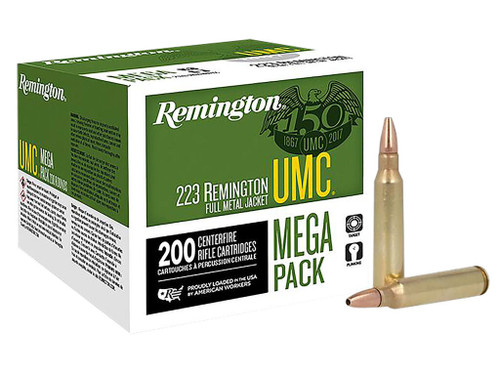 Remington Ammunition 23775 UMC Mega Pack 223Rem 45gr Jacketed Hollow Point 200 Per Box/4 Case$177.51
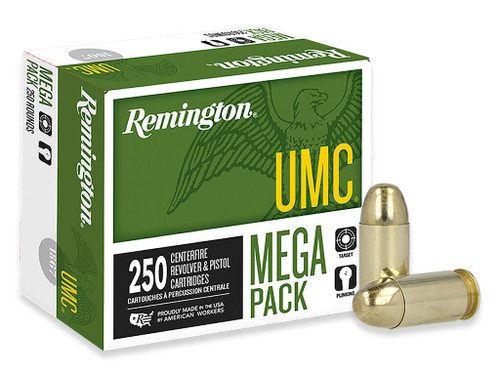 Remington Ammunition 23781 UMC Mega Pack 45ACP 230gr Full Metal Jacket 250 Per Box/4 Case$133.78
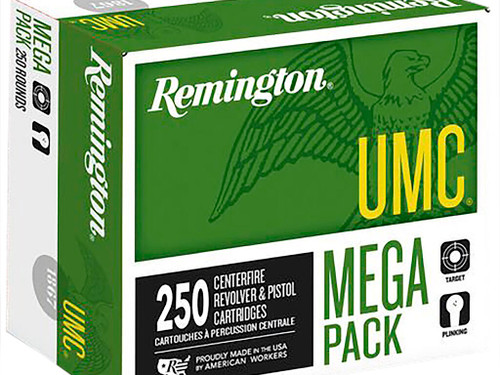 Remington Ammunition 23779 UMC Mega Pack 40S&W 180gr Full Metal Jacket 250 Per Box/4 Case$119.72
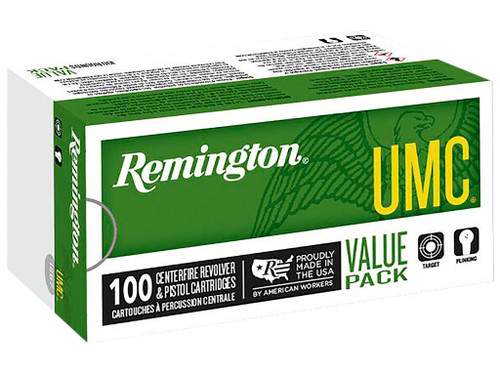 Remington Ammunition R23970 UMC Value Pack 357Mag 125gr Semi Jacketed Hollow Point 100 Per Box/6 Case$86.24